Charles Trevelyan
Charles Trevelyan was born in 1974 in Australia. After studying material science and engineering in Australia, Trevelyan navigated a gradual transition from the sciences to the arts by way of industrial and furniture design before finding a more natural fit for his process-led design practice in collectible design. Along the way, Trevelyan developed an approach that references a diverse spectrum of influences including the striking organic forms, natural textures and colour palettes that surrounded him during his upbringing in Australia, the geological and crystalline morphology that he encountered through electron microscopy projects from his earlier career, and more recent interests such as the extraordinary range of intriguing and unintentional graphical patterns found in aerial photographs that result from the way in which agricultural land usage must be optimised around naturally occurring landforms.
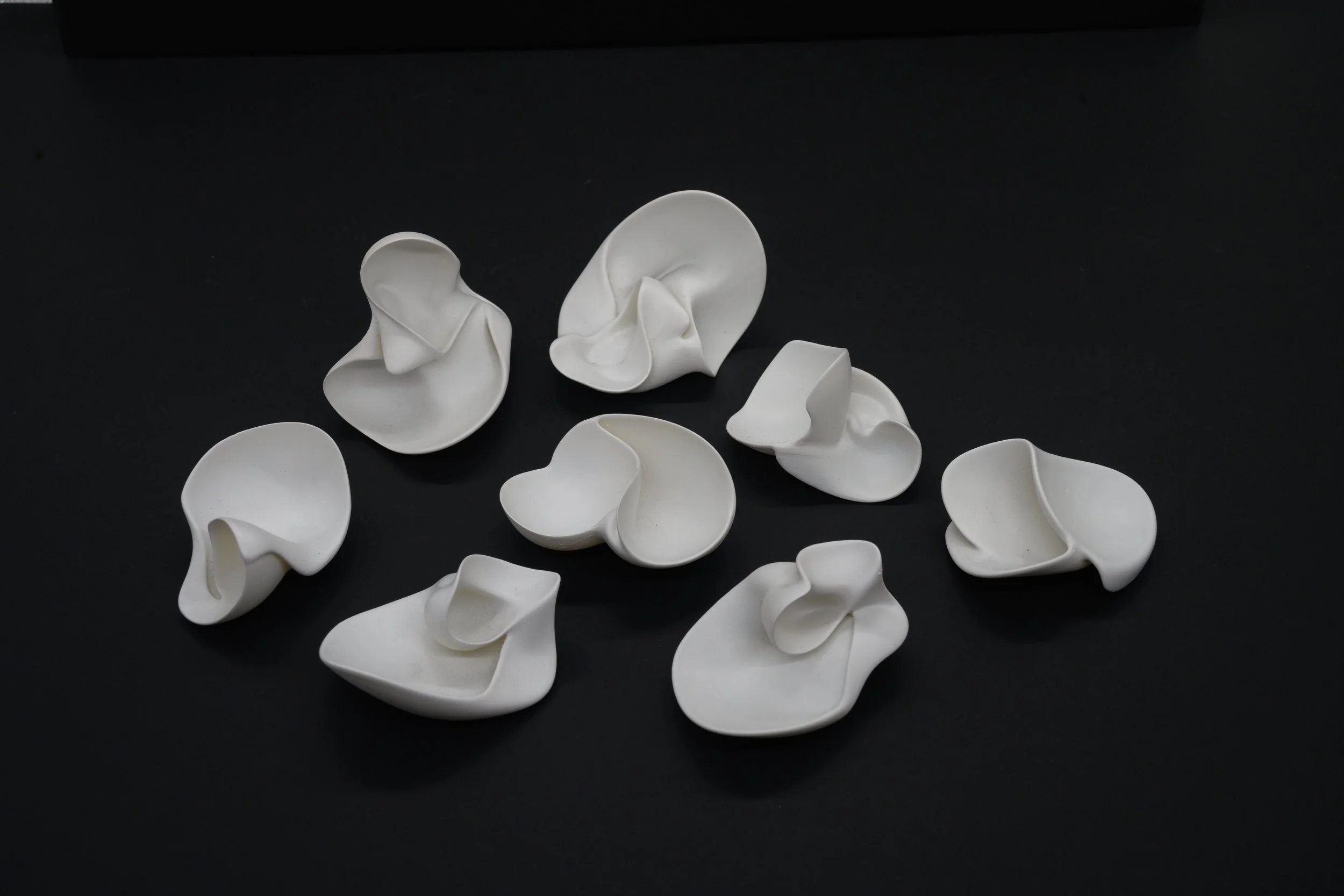
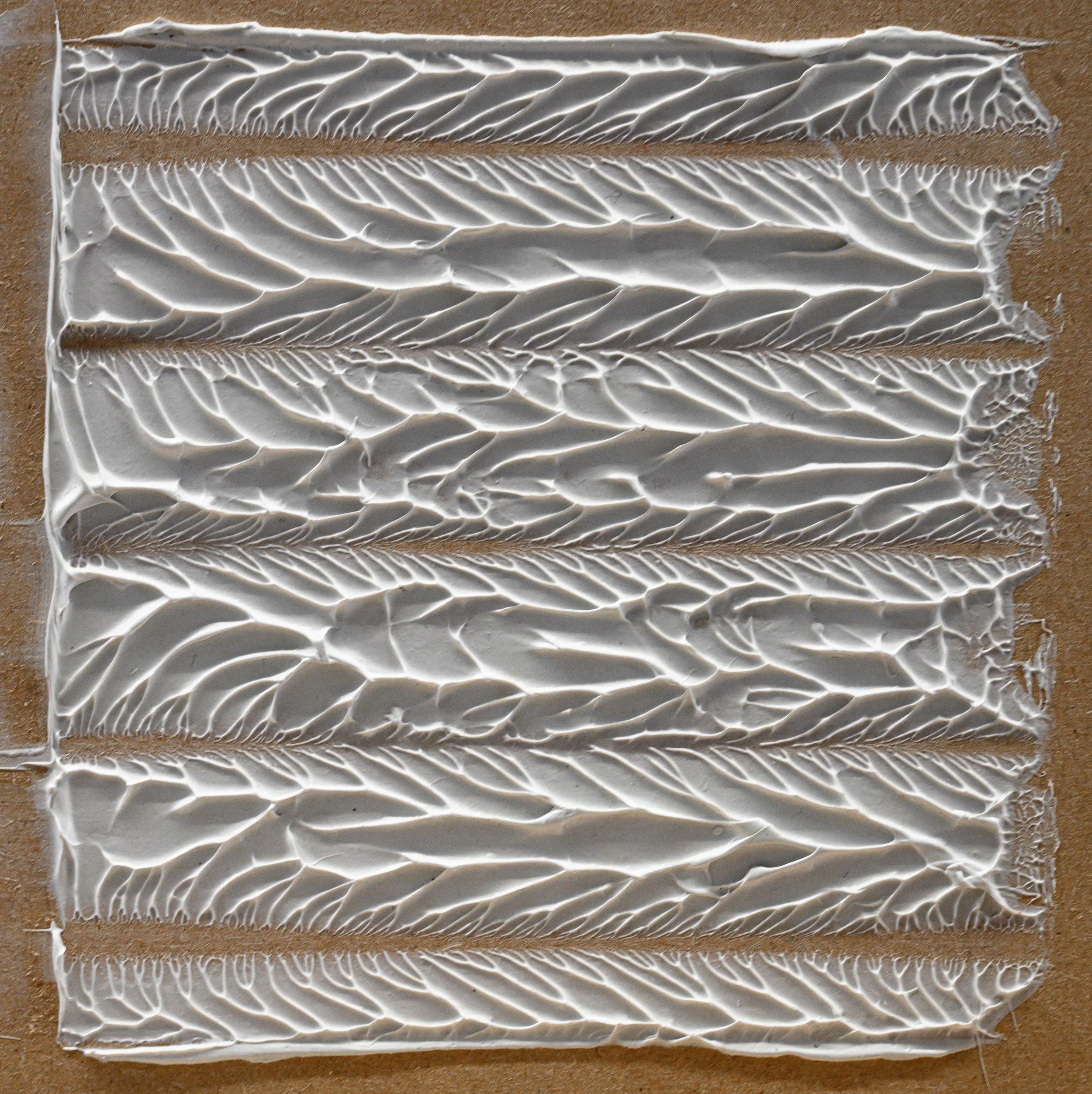
Trevelyan is interested in the degree to which our personal preferences on form can be shaped by, for example, subtle variations in the balances between symmetry and asymmetry, simplicity and complexity, or regularity and irregularity and how these in turn influence the way in which each individual responds to an object. A common misconception of the work is that it involves the direct creation of simulacra of forms or textures from the natural world. A more accurate encapsulation is that the works are carefully designed to elicit the same responses in the viewer that one may experience on encountering a natural object. This is accomplished by creating forms that may appear superficially similar to those found in nature, yet are derived from processes that are fundamentally different in origin and material. One example is the series of complex organic-looking textures developed in the studio through a process of photographing simple geometric graphical patterns through multi-layered optical elements. The lines on the page are distorted in a kaleidoscopic manner, becoming curved and variegated, producing a complex black and white patterning that can be digitally extrapolated into a three-dimensional texture. The output of the process is a deeply textured surface that appears highly organic in character, reminiscent of the Fibonacci type morphology of pine cones or the complex layered exoskeletons of the insect world.
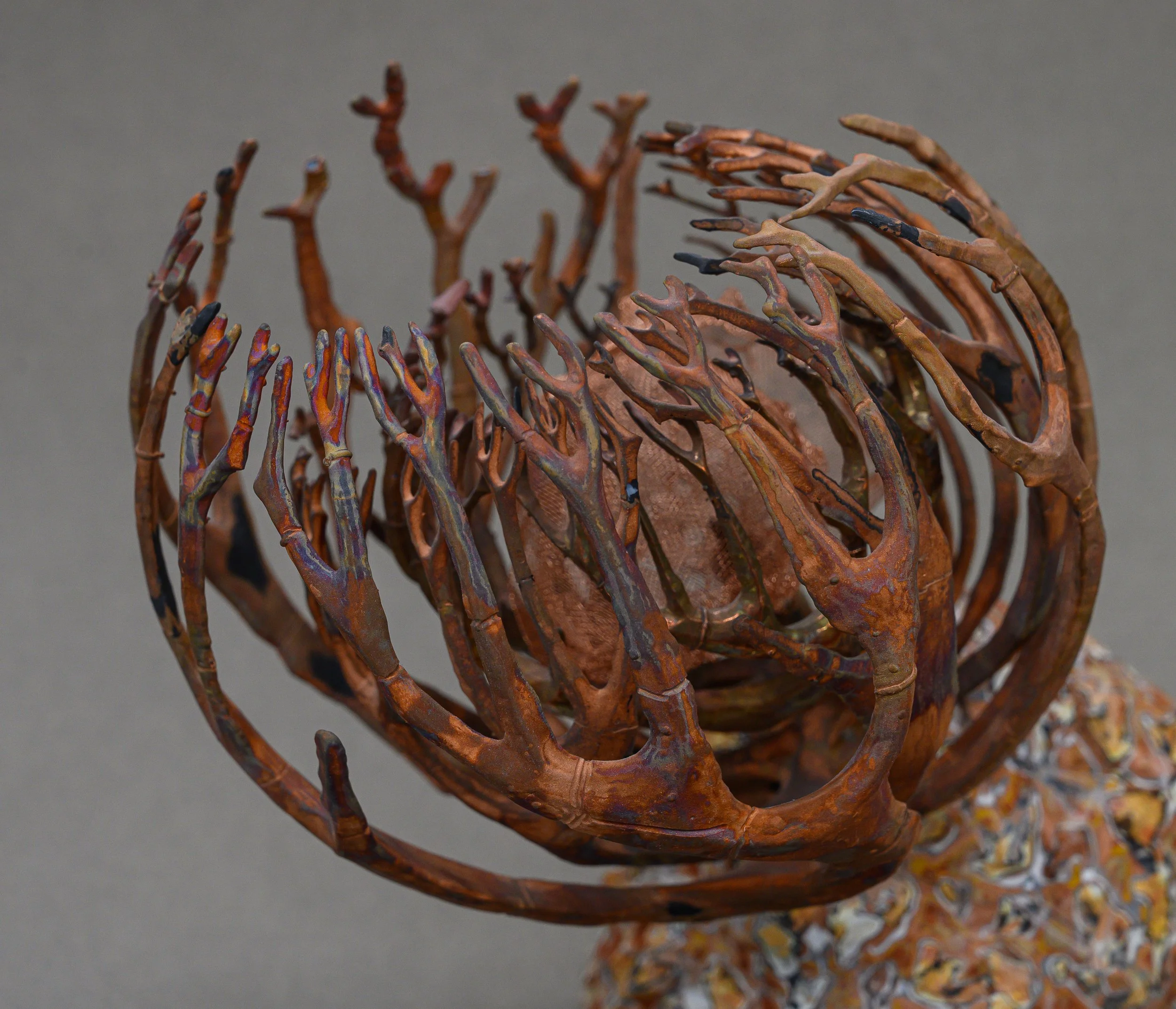
Pursuing such approaches requires Trevelyan’s practice seeks to establish a framework of long-term experimentation and development that anchors the creation of sculptural pieces in a rigorous and research-led process of investigation. This requires the development of underlying processes that themselves are carefully constructed to output a specific and repeatable set of forms, textures or material manipulations that in turn become the characteristic identity for the final completed works. As such, the design process is less about design per se and more about the curation and manipulation of a generative system. Once something of interest emerges, the process is then further refined to the point where it is both clearly understood and capable of reliably outputting suitable precursors for the design development of the functional final works. These may take the form of a complex branching structure formed by the application of viscous acrylics using finely detailed silicone moulds, the photographs of optically distorted graphical patterns mentioned earlier, or sculptural forms generated by the analysis of the waveforms of sounds that were themselves sculpted using audio equipment.
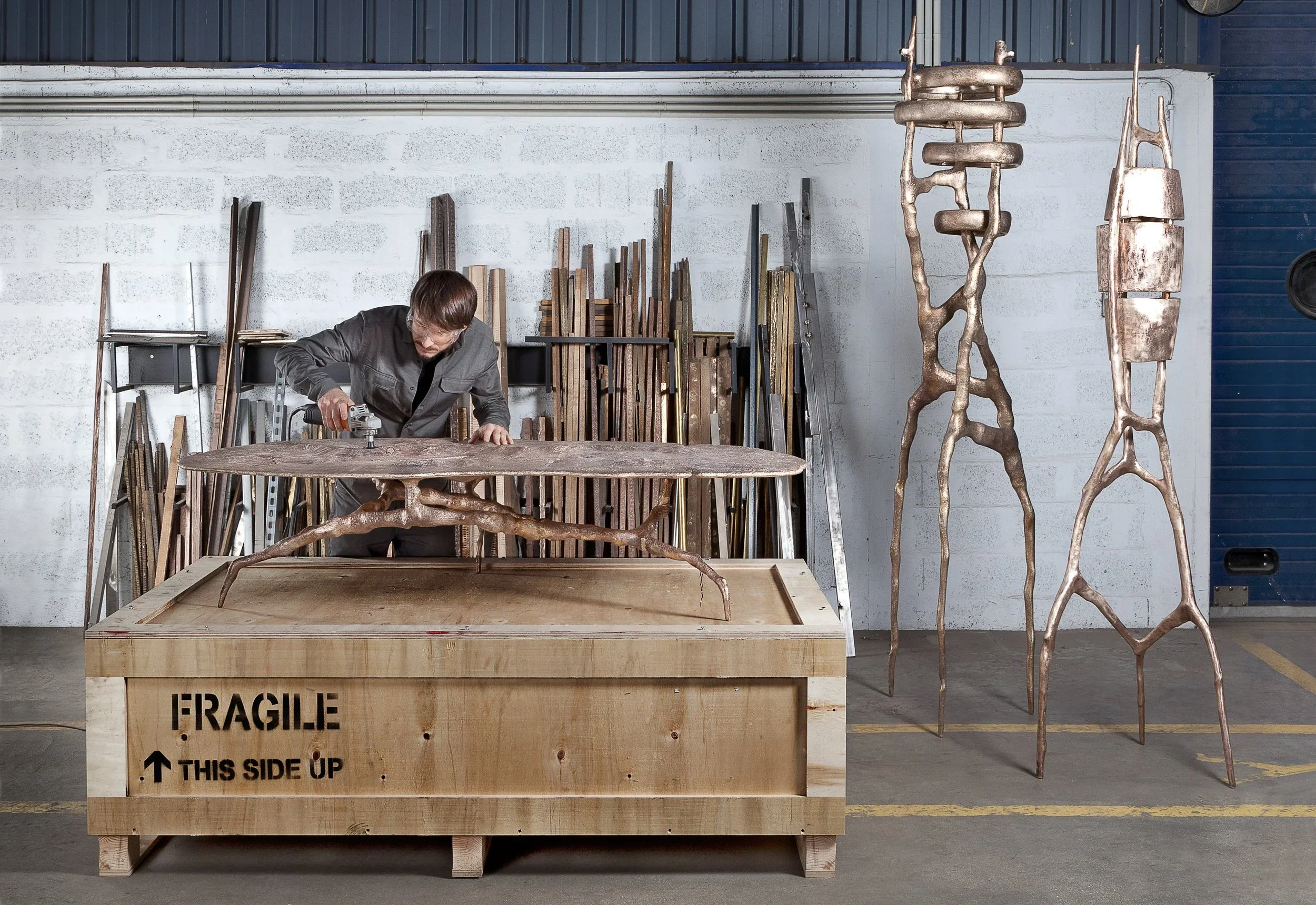
More broadly, these examples illustrate the hybrid manual/digital process that is integral to the creation of almost every work. Most projects involve a number of stages of conversion back and forth between digital models and hand-made objects through 3D printing and scanning, hand sculpting and texturing, and digital modelling and manipulation. Neither the digital nor manual elements are purely functional; both are carefully tailored in such a way as to contribute cumulatively to final, unique fingerprint of the piece, whether in aesthetically or material terms. The creation of any work therefore involves the production of numerous different maquettes, physical experiments, textures and models with interesting accidents along the way feeding into the distinct identity of the finished piece.
Trevelyan’s work has been presented at numerous fairs and exhibitions at the Design Museum, Design Miami, Design Miami Basel, Pad London, TEFAF Maastricht, and India Art Fair among others, and he has further exhibited his work widely across the globe in exhibitions in the United States, Europe, the Middle East and Australia. He is currently represented by Carpenters Workshop Gallery and Gallery Sally Dan Cuthbert.